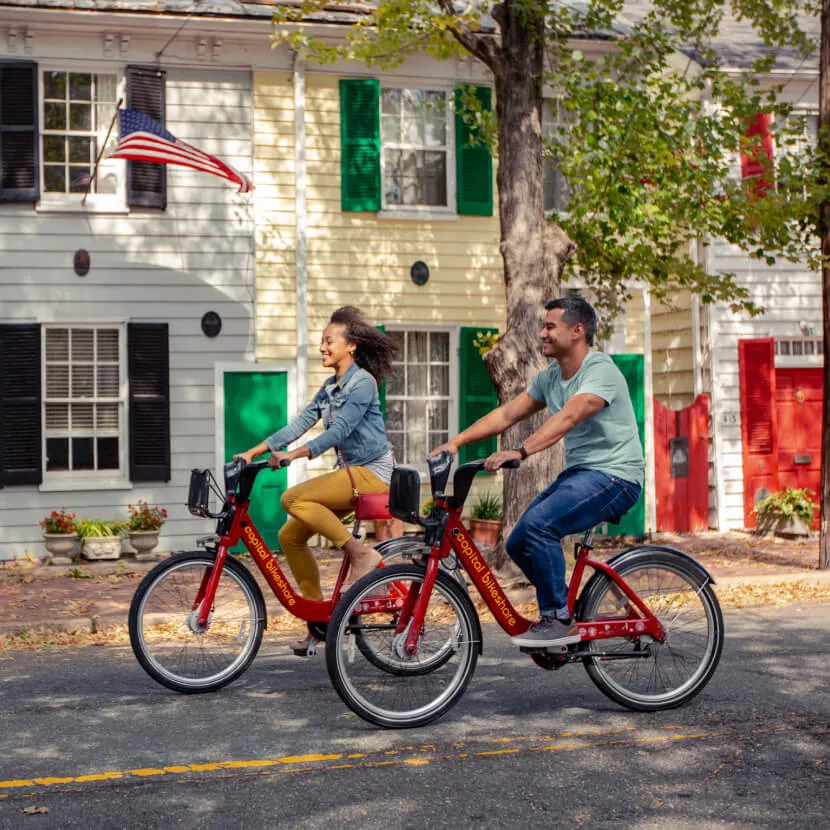
Begin at the intersection of S. Washington Street and Prince Street and walk east (past the courthouse) on Prince Street.
517 Prince Street
Private Residence
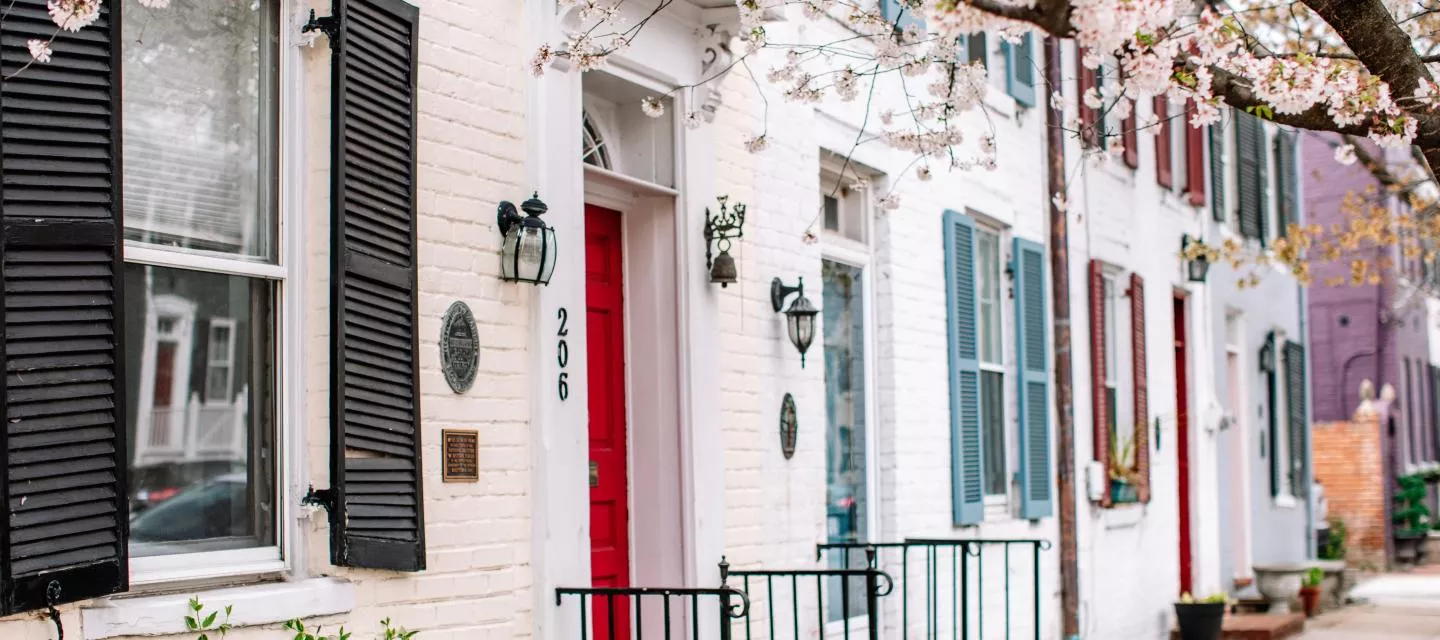
Built around 1775 by Patrick Murray, who acquired the quarter block on which it stands on December 20, 1774, this house is typical of most of the better homes built in Alexandria during George Washington's day. The framed house was advertised by Murray in 1792 as having four rooms and three fireplaces on the first floor, two rooms on the second floor, and a kitchen annex. Purchased by John Douglas Brown in 1816 and owned by one family thereafter, it is perhaps the least altered of the surviving early buildings.
Continue east on Prince Street.
Private Residences
These houses, most of which were built by Captain John Harper, comprise what is considered the finest 18th century street facade in Alexandria, The house at 211, completed in the summer of 1793, was once occupied by Dr. Elisha Cullen Dick. Dr. Dick may also have lived in the house at 209, after Dr. James Craik moved from there to 210 Duke Street in 1796. Both physicians treated George Washington during his final illness.
Return to the corner of Prince Street and S. Fairfax Street; turn right; walk north partway up the block.
105-107 S. Fairfax Street
Nov-Mar: 11 am to 4 pm Wed-Sat; 1 pm to 4 pm Sun; closed major holidays
Apr-Oct: 10 am to 5 pm Tues-Sat; 1 pm to 5 pm Sun-Mon; closed major holidays
Admission: Adults $4; children ages 11-17 $2; children under age 11 free with paying adult
Founded in 1792, this apothecary shop counted among its earliest customers George and Martha Washington. At the time it closed in 1933, it was the oldest shop in Virginia and the second oldest in the U.S. in continuous operation. It has been meticulously maintained and holds the largest, most valuable collection of medicinal glass in the country.
Proceed to the corner of S. Fairfax Street and King Street; cross to the northeast corner of King Street and N. Fairfax Street; continue walking north on N. Fairfax Street
121 N. Fairfax Street
10 am to 4 pm Tues-Sat; 12 pm to 4 pm Sun
Admission: Adults $4; children ages 11-17 $2; children under age 11 free with paying adult
Built in 1751-1753 by John Carlyle, one of Alexandria's founders and friend of George Washington. The Georgian Palladian-style mansion was used in 1755 as the headquarters of British General Edward Braddock, whom George Washington served as aide-de-camp. Guided tours explore such topics as family life of the colonial Virginia aristocracy, merchants, slavery and servants, and town property.
Proceed to the corner of N. Fairfax Street and Cameron Street; cross Cameron Street.
201 N. Fairfax Street
Private Residence
Originally, this structure was a tavern, which was under construction in 1777, when John Dalton died, and was completed by his son-in-law Thomas Herbert. George Washington came to dine here on September 26, 1785, when the tavern owner was Henry Lyle. In the early 19th century, the tavern was converted into two residences.
Cross N. Fairfax Street and continue west on Cameron Street.
305 Cameron Street
Private Residence
On December 31, 1783, General George Washington was feted at William Duvall's tavern by the gentlemen of the town at the conclusion of the Revolutionary War. From 1788 to 1791, Charles Lee, then Collector of the Port, resided here; from 1793 to 1807, it served as the banking house of the Bank of Alexandria; and, since then, it has been a private residence.
Proceed to the intersection of Cameron Street and N. Royal Street.
134 and 138 N. Royal Street
Nov-Mar: 11 am to 4 pm Wed-Sat; 1 pm to 4 pm Sun; last tour at 3:45 p.m.
Apr-Oct: 10 am to 5 pm Tues-Sat; 1 pm to 5 pm Sun-Mon; last tour at 4:45 p.m.
Closed major holidays
Tours start at a quarter after the hour and a quarter before the hour, lasting approximately 30 minutes
Admission: Adults $4; children ages 11-17 $2; children under age 11 free with paying adult
The City Tavern (ca. 1785) and adjoining City Hotel (1792), were the site of birthnight balls for George Washington and an inaugural party for Thomas Jefferson. Around the corner, on Cameron Street, is a very important part of Gadsby's Tavern: the brick-walled underground ice house, which was filled every winter with ice from the Potomac River. In front of the tavern museum is a cannon left behind by British General Edward Braddock, which was made into a watering fountain for animals.
Continue west on Cameron Street.
508 Cameron Street
Private Residence
George Washington purchased this lot in 1763, and his town house was completed in 1769. He maintained an office with a secretary here to receive and accommodate belated visitors to Mt. Vernon. The house, noted for its simplicity of design, was torn down in 1855. In 1960, Gov. and Mrs. Richard Barrett Lowe had the house rebuilt on the original foundation, using bricks and stones from the excavation.
Continue west on Cameron Street.
607 Cameron Street
Private Residence
This town house was designed and built in 1801-1802 by William Yeaton, who also designed the tomb for George and Martha Washington at Mt. Vernon. From 1830 to 1846, Thomas, ninth Lord Fairfax, resided here with his family. Thomas' father, Bryan Fairfax, was an intimate friend of George Washington and an early rector of Christ Church.
Continue west on Cameron Street; cross N. Washington Street; and enter the grounds of Christ Church.
118 N. Washington Street
9 am to 4 pm Mon-Sat; 2 pm to 4:30 pm Sun
Admission: Free
Both George Washington and Robert E. Lee were regular worshipers at Christ Episcopal Church, and both their pews are marked - Washington's has been preserved in its original state. The English country-style church was built between 1767 and 1773. The churchyard holds the graves of early residents and war veterans.
Exit the grounds onto N. Washington Street; turn right, and return south along Washington Street to The Lyceum.